

Equipment Service
Undercarriage Maintenance
Undercarriage Maintenance
##
CONSTRUCTION EQUIPMENT UNDERCARRIAGE MAINTENANCE: SPOT PROBLEMS QUICKLY
Monitor your undercarriage routinely
- Don’t delay repairs or replacements on undercarriage components
- Any make, any model
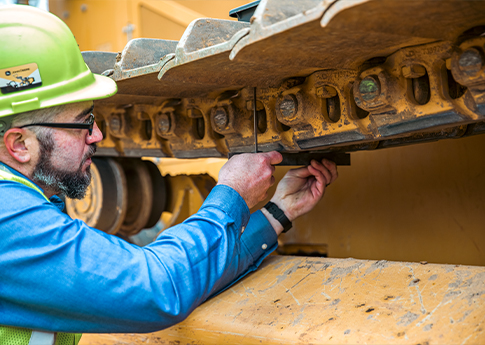
Used&New Tractors and Equipments (UNT&E)’s technicians are trained to identify undercarriage problems before major repairs are required. By measuring the thickness of the undercarriage components, our technicians can predict how long your undercarriage will last before replacements are needed. During preventive maintenance service, we can include undercarriage evaluations at an additional charge.
UNDERCARRIAGE TIPS TO REDUCE WEAR
Extend the life of your undercarriage by following a few simple rules.
ADJUST THE TRACK FOR CORRECT TENSION
Loose tracks can detract. Over-tightening can cause power loss and excessive roller and idler wear, and it could tear the tracks. Refer to your operator’s manual for track inspection and tensioning procedures.
USE THE NARROWEST SHOE POSSIBLE
Wider shoes can cause problems maneuvering by sticking out farther and making it more difficult to turn. Wider shoes may be necessary, however, to keep the machine from sinking in extremely wet conditions.
KEEP THE UNDERCARRIAGE CLEAN OF MUD AND DEBRIS
The accumulation of mud and dirt around the undercarriage can interfere with proper operation by changing the pitch, which changes the component engagement and leads to faster wear. Knock away any debris every day after use, and then wash the tracks thoroughly with water.
MINIMIZE HIGH OPERATING SPEEDS
Higher speeds cause more wear on the undercarriage. Use the slowest possible operating speed for the job.
ALTERNATE THE TURNING DIRECTION
Continuous turning to the same side can cause asymmetrical wear and accelerate wear for sprocket teeth, track tread, guide lugs and roller flanges.
INSPECT YOUR EQUIPMENT VISUALLY EVERYDAY FOR SIGNS OF WEAR
Check for cracks, bends, and breaks on components. Look for wear on bushings, sprockets, and rollers. If you see any components that are shiny, there’s probably an alignment problem. Make sure nuts and bolts are not loose, which can cause abnormal wear by interfering with proper movement of parts.
CONTROL TRACK SPINNING WHEN FILLING THE BUCKET
Use loader hydraulics to penetrate into the material to reduce track spinning. Unnecessary spinning of the tracks can accelerate wear and cause cuts in the tracks.
Details & common questions
ADJUST THE TRACK FOR CORRECT TENSION
Loose tracks can detract. Over-tightening can cause power loss and excessive roller and idler wear, and it could tear the tracks. Refer to your operator’s manual for track inspection and tensioning procedures.
USE THE NARROWEST SHOE POSSIBLE
Wider shoes can cause problems maneuvering by sticking out farther and making it more difficult to turn. Wider shoes may be necessary, however, to keep the machine from sinking in extremely wet conditions.
KEEP THE UNDERCARRIAGE CLEAN OF MUD AND DEBRIS
The accumulation of mud and dirt around the undercarriage can interfere with proper operation by changing the pitch, which changes the component engagement and leads to faster wear. Knock away any debris every day after use, and then wash the tracks thoroughly with water.
MINIMIZE HIGH OPERATING SPEEDS
Higher speeds cause more wear on the undercarriage. Use the slowest possible operating speed for the job.
ALTERNATE THE TURNING DIRECTION
Continuous turning to the same side can cause asymmetrical wear and accelerate wear for sprocket teeth, track tread, guide lugs and roller flanges.
INSPECT YOUR EQUIPMENT VISUALLY EVERYDAY FOR SIGNS OF WEAR
Check for cracks, bends, and breaks on components. Look for wear on bushings, sprockets, and rollers. If you see any components that are shiny, there’s probably an alignment problem. Make sure nuts and bolts are not loose, which can cause abnormal wear by interfering with proper movement of parts.
CONTROL TRACK SPINNING WHEN FILLING THE BUCKET
Use loader hydraulics to penetrate into the material to reduce track spinning. Unnecessary spinning of the tracks can accelerate wear and cause cuts in the tracks.